
Buckwheats by Suzanne Schettler
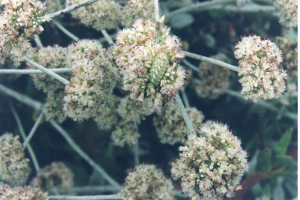
Species of buckwheat (Eriogonum) have flowers mainly in whites and pinks. They are mostly rounded woody shrubs of various heights. Grey foliaged ones generally have fuzzy surfaces and the green ones are smooth. One thing they have in common is tiny flowers arranged in round clusters. They also prefer full sun and lean, dry soil.
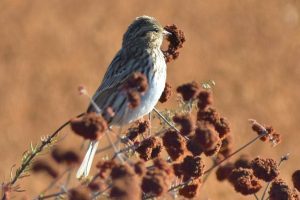
At the shore we have E. latifolium, with rounded grey leaves on a fairly short plant. Usually white-flowered, it also occurs in a pink form that is ornamental. E. parvifolium is a knee-high to waist-high dense green shrub that grows in the coastal dunes of southern Monterey Bay.
E. fasciculatum (California buckwheat) is an interior form from farther inland. Buckwheats are attractive to bees, who make a dark, rich honey from the nectar.
The rare naked-stemmed buckwheat (E. nudum decurrens) of the Sandhills is a spindly knee-high thing. It makes up for its lack of leaves on the nude stems because the petioles of the leaves are decurrent (extending down the stem) and perform the photosynthetic function of leaves.
Eriogonum arborescens, Santa Cruz Island buckwheat, is a medium shrub with greyish foliage that is naturalized at Seacliff and Manresa State Beaches.
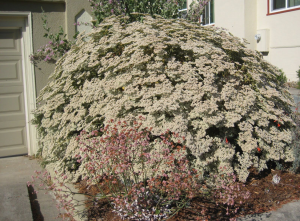
Though not a local native, St. Catherine’s Lace (E. giganteum) from the Channel Islands is an attractive large shrub with big flat clusters of white flowers that age to a rust color. Florists use them in dry flower arrangements. The U.C. Davis Arboretum considers it a good wildlife plant; besides honey bees, it supports native bees, birds and small mammals, and hosts a likely total of 12 species of butterfly and moths.
For the warm half of the year, there is always at least one kind of buckwheat in bloom.