
Coffee beans and California coffeeberry
Life is boring, except for flowers, sunshine, your perfect legs. A glass of cold water when you are really thirsty….Coffee in the morning. These are just moments. –Pablo Neruda
I didn’t drink coffee until I moved to Berkeley to study botany. Late night discussions with other graduate students in the Life Science Building were fueled by caffeine…who could resist? Then my botanical research took me to Central America where I fell in love with coffee trees. My friend Gloria suggested a trip to Antioquia in Colombia to see her grandfather’s coffee plantation. When he retired, he left land to the campesino families who had worked for him for many years–an unusual reward then and now.
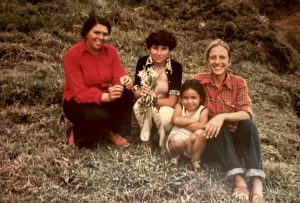
One family welcomed us to stay in their humble home in Fredonia, surrounded by acres of Coffea trees. The area was beautiful, with tall trees full of wild orchids and smaller coffee trees, their branches studded with hundreds of jewel-like fruit. The father was stunned to hear that Colombian coffee was five dollars a pound in California (at that time) when the going rate for his raw coffee beans was 50 cents a pound. I hiked in the hills with his three daughters. It was a magical visit with hard-working people.
Years later, hiking in Pogonip Open Space, I discovered a bush with fruit that resembled the coffee beans of Fredonia. However, it wasn’t Coffea. The Pogonip plant was California coffeeberry–Frangula californica, an attractive native shrub with colorful berries and a valuable role in local ecosystems. In springtime, the small, green flowers attract pollinating insects. The coffeeberry is a food source for native birds: robins, scrub jays, mockingbirds, thrashers, and thrushes. Don’t eat the raw fruit or brew a drink; it can be toxic to humans.
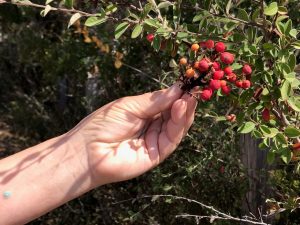
Vivian Mazur of the Inverness Garden Club writes “Coffeeberry is useful in the garden as an understory or background plant. Where screening is desired, it makes a fine informal hedge. It is also amenable to pruning so it can be shaped to emphasize its arborescent structure. It combines well with toyon, sages, ceanothus and other plants of the dry garden. There are several named cultivars: ‘Eve Case’ is smaller and more compact than the species with large berries; ‘Seaview’ is a ground cover variety; ‘Mount St. Bruno’ has a dense habit and is particularly tolerant of garden conditions. Coffeeberry’s virtue is in its adaptability; it will happily thrive in sun or shade and is unfussy about soil. It is an ideal plant for the sustainable garden.”
Think back on every hike or garden or park that inspired your love of native plants. Imagine enjoying your morning coffee (Colombian, of course) while you observe birds feasting on the fruits of your labor, the fruits of your own California bush. These are moments to treasure.
order Rosales, buckthorn family Rhamnaceae, genus and species Frangula californica